

Only 12% of Finance Teams Use AI — The Early Adopter Advantage
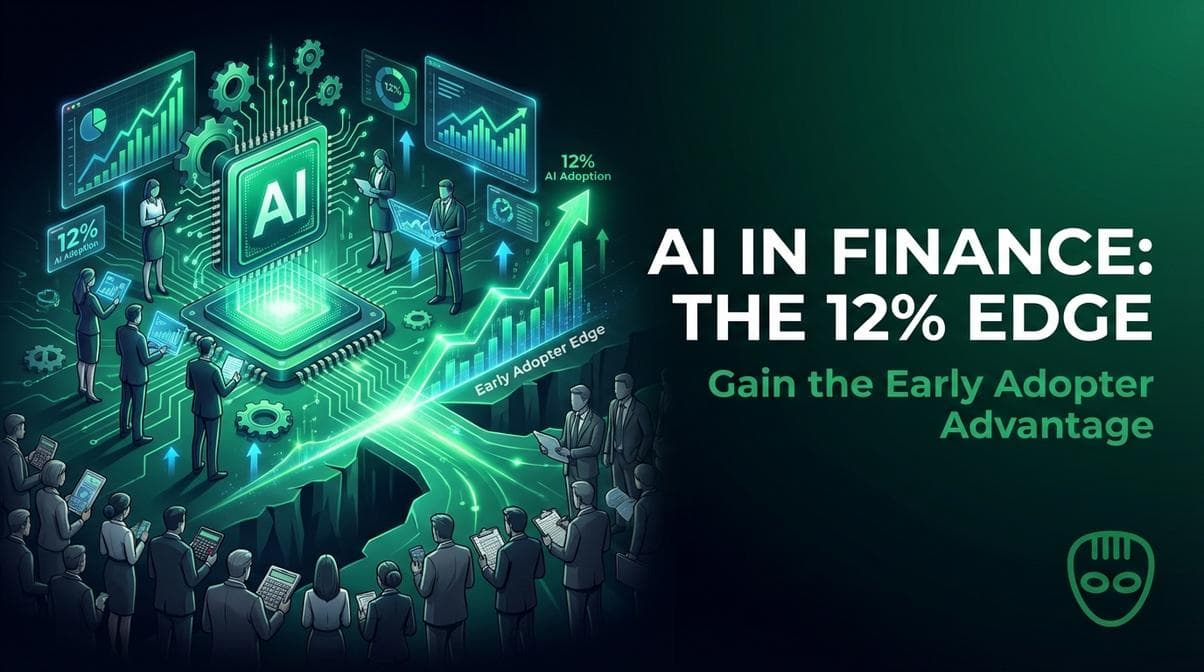
84% of Finance Teams Are Drowning in Manual Work While 12% Have Already Escaped. Which Group Are You In?
A new survey just dropped that should alarm every small business owner still managing finances the old way.
According to Accounting Seed's State of AI in Accounting 2026 report, published this month, only 12% of SMB finance teams are actively using AI tools. Meanwhile, 63% remain stuck in "evaluation mode" — still researching, still planning, still waiting.
And here's the number that should really get your attention: 84% of finance teams still spend at least 25% of their time on repetitive manual tasks.
That's not a technology gap. That's a competitive chasm — and it's widening every month.
The Great Divide: Early Adopters vs. Everyone Else
The survey data paints a clear picture of two distinct groups emerging in small business finance:
Group 1: The 12% (Active AI Users)
These businesses have moved beyond experimentation. They're using AI for:
- Automated transaction categorization — no more manual sorting
- Real-time cash flow forecasting — seeing problems 30-60 days ahead
- Instant financial analysis — answers in seconds, not days
- Anomaly detection — catching errors before they compound
The result? They're spending their time on strategy, growth, and client relationships — not data entry.
Group 2: The 63% (Still Evaluating)
These businesses know AI is important. They've read the articles. They've maybe even signed up for a trial or two. But they haven't committed. They're stuck in perpetual evaluation mode, citing concerns about:
- Data security (understandable, but solvable)
- Integration complexity (mostly a myth in 2026)
- Fear of errors (ironic, given human error rates)
- "Not enough time" to implement (the cruelest irony)
Group 3: The Remaining 25% (Not Even Looking)
This group hasn't engaged with AI at all. If you're in this category, the urgency is even higher — but the good news is you can leapfrog directly to modern tools without legacy baggage.
Why the Gap Is About to Become a Gulf
Here's what the survey reveals about the competitive dynamics at play:
| Metric | AI Adopters | Non-Adopters |
|---|---|---|
| Time on manual tasks | < 10% | 25-50% |
| Cash flow visibility | Real-time | Monthly (at best) |
| Error rate on categorization | < 5% | 15-25% |
| Time to financial insights | Minutes | Days to weeks |
| Revenue growth (businesses using AI) | 2x more likely to grow | Baseline |
That last statistic comes from broader industry research: small businesses consistently using AI are twice as likely to see revenue increases.
The math is simple. If you're spending 10+ hours monthly on tasks AI can handle, you're effectively donating that time to competitors who've already automated.
The Three Barriers Holding Teams Back (And Why They're Smaller Than You Think)
The Accounting Seed survey identified the top barriers preventing AI adoption. Let's examine each one:
Barrier 1: Data and Integration Concerns
The Fear: "Our data is messy. Our systems won't talk to each other. Integration will be a nightmare."
The Reality: Modern AI accounting tools are designed to connect with the messy reality of small business systems. They integrate natively with QuickBooks, Xero, Stripe, and major banking platforms. The setup that once took weeks now takes hours.
Tools like Profit Leap's CFO bot use read-only API connections — meaning they analyze your data without modifying it. The integration risk is essentially zero.
Barrier 2: Security and Privacy Worries
The Fear: "I can't trust AI with my financial data. What if it gets hacked? What about privacy?"
The Reality: Legitimate AI accounting tools maintain SOC 2 compliance, bank-level encryption, and strict data governance. In many cases, your data is more secure with a properly-configured AI tool than it is in the spreadsheets currently sitting in your email inbox.
The key is choosing established providers with documented security practices — not experimental tools from unknown vendors.
Barrier 3: Fear of AI Errors
The Fear: "What if the AI categorizes something wrong? What if it makes a mistake the IRS catches?"
The Reality: AI systems in 2026 achieve 95%+ accuracy on transaction categorization — significantly better than the human error rates in manual bookkeeping. More importantly, they're designed for human review: you approve categories, you catch exceptions, you maintain control.
The question isn't whether AI makes mistakes. It's whether AI makes fewer mistakes than the current process. The data says yes.
What Early Adopters Actually Experience
Let's get specific about what changes when a small business moves from manual finance management to AI-assisted operations.
Before AI: The Monthly Scramble
- Week 1: Download bank statements, credit card statements, payment processor reports
- Week 2: Manually categorize hundreds of transactions in spreadsheets or accounting software
- Week 3: Reconcile discrepancies, chase down missing receipts, correct miscategorizations
- Week 4: Generate reports, realize something's off, start troubleshooting
Total time: 15-25 hours monthly Accuracy: Variable, errors compound over time Cash flow visibility: Retrospective only
After AI: The Continuous Flow
- Daily: AI automatically categorizes transactions as they occur
- Weekly: 10-minute review of flagged items and edge cases
- Monthly: 30-minute strategic review with accurate, current data
- On-demand: Ask questions, get instant answers based on real numbers
Total time: 2-4 hours monthly Accuracy: 95%+ with human oversight Cash flow visibility: Real-time, with forecasting
The time savings alone — 15-20 hours monthly — would justify the switch. But the strategic advantage of real-time visibility is where the real value compounds.
The "Agentic AI" Wave: Why 2026 Is the Inflection Point
Industry analysts point to 2026 as a pivotal year for AI in accounting. The reason? The emergence of "agentic AI" — systems that don't just analyze data but take actions.
According to Accounting Today's AI Thought Leaders Survey, the next wave of AI tools will:
- Automatically send cash confirmation requests to banks
- Fill out compliance forms based on your data
- Flag discrepancies and suggest resolutions
- Prepare draft reports for human review
This isn't theoretical — major vendors are shipping these capabilities now. The businesses that have already adopted AI will seamlessly upgrade. Those still on the sidelines will face an even steeper learning curve.
The Small Firm Advantage (Yes, Advantage)
Here's something the big accounting firms don't want you to know: AI actually benefits smaller businesses more than larger ones.
Why? Because small businesses have:
- Less technical debt — no legacy systems to untangle
- Faster decision cycles — one person can say "yes" and implement
- More to gain — each hour saved matters more when you're wearing multiple hats
- Direct feedback loops — you see results immediately
A Stanford GSB study found that professionals using AI tools can support more clients, close books faster, and provide higher-quality service. For a solo operator or small team, that translates directly into capacity for growth.
The 12% of SMBs actively using AI aren't all well-funded startups. Many are small businesses run by owners who simply decided to stop waiting.
How to Move From the 63% to the 12%
Ready to stop evaluating and start implementing? Here's a practical roadmap:
Week 1: Audit Your Current State
- How many hours monthly do you spend on manual financial tasks?
- What's your current error rate on categorization?
- How far ahead can you see your cash flow?
- What questions can't you answer quickly about your finances?
Week 2: Choose One Starting Point
Don't try to automate everything at once. Pick the highest-impact area:
- If you spend hours categorizing transactions: Start with AI-powered bookkeeping automation
- If you're constantly surprised by cash crunches: Start with AI cash flow forecasting
- If you can't get quick answers about your business: Start with an AI financial assistant
Week 3: Implement With Training Wheels
Choose a tool that connects to your existing accounting software. Set it up in review mode — where AI suggests actions but you approve them. Build confidence before full automation.
Week 4: Measure and Adjust
Track your time savings. Note which AI suggestions you override. Feed those corrections back into the system. Modern AI learns from your patterns.
Where Profit Leap Fits In
For small business owners who want to skip the complexity, Profit Leap's CFO bot represents the fastest path from manual chaos to AI-powered clarity.
Here's how it addresses the top adoption barriers:
Integration concerns? CFO bot connects directly to QuickBooks, Xero, and Stripe. Setup takes less than an hour. No IT department required.
Security worries? Read-only API access, SOC 2 compliant infrastructure, bank-level encryption. Your data is analyzed, never modified without your explicit action.
Fear of errors? Every insight shows its reasoning. Every recommendation can be verified. And for complex questions, a CPA backstop ensures you're never navigating compliance alone.
The 24/7 availability means you can ask questions at 11 PM when you're finally catching up on finances — not during business hours when you're serving customers.
The Cost of Waiting
Let's quantify what another year of manual financial management actually costs:
Direct time cost: 15-20 hours monthly × 12 months = 180-240 hours annually At $75/hour opportunity cost: $13,500-$18,000 in lost capacity
Indirect costs:
- Late payments from poor cash visibility: $500-2,000 annually
- Missed early-payment discounts: $300-1,000 annually
- Tax overpayment from missed deductions: $1,000-5,000 annually
- Decision delays from slow data: Unquantifiable but real
Total annual cost of manual finance management: $15,000-25,000 in time and money
Compare that to AI tools costing $50-200 monthly. The ROI isn't close.
The Bottom Line
The Accounting Seed survey tells a stark story: 12% of SMB finance teams have embraced AI and are capturing real advantages. 84% are still drowning in manual work that machines could handle.
The gap between these groups will only widen as agentic AI capabilities mature in 2026 and beyond. The businesses that implement now will compound their advantages. Those still evaluating will face increasingly steep catch-up costs.
The barriers that once justified waiting — integration complexity, security concerns, accuracy fears — have largely dissolved. What remains is simply the decision to act.
The question isn't whether AI will transform small business finance. It already has, for the 12% who've adopted. The only question is whether you'll join them.
Ready to put your finances on autopilot? Try CFO bot risk-free with a 7-day money-back guarantee →