

93% of CFOs Say AI Isn't Paying Off — Here's What Works
60% of Finance Teams Are Using AI — So Why Aren't the Numbers Moving?
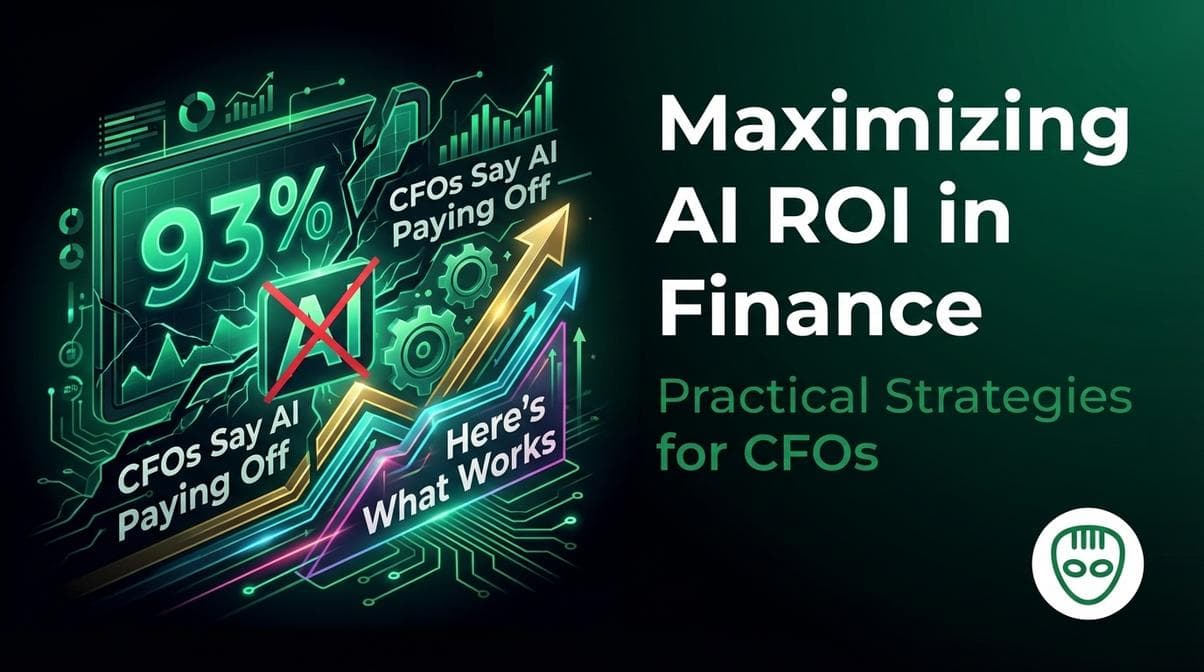
There's a stunning disconnect at the heart of the AI-in-finance revolution. According to the Journal of Accountancy's April 2026 deep dive into AI and automation in finance, close to 60% of finance teams are now piloting or fully implementing AI projects. That sounds like progress — until you see the other number. A Gartner report cited in the same analysis found that only 7% of CFOs report a strong impact from their AI investments.
That's a 93% disappointment rate. And for small business owners who've been told AI will transform their financial operations, it raises an uncomfortable question: is everyone doing AI wrong, or is the technology just not ready?
The answer, it turns out, is neither. The problem isn't AI itself — it's how most businesses are deploying it. The 7% who are seeing real results share a set of patterns that the other 93% are missing. Here's what separates them.
Why Most AI Finance Projects Stall
The "Shiny Tool" Trap
Most businesses start their AI journey by picking a tool first and finding a problem second. They hear about a new AI feature in their accounting software, turn it on, and wait for magic to happen.
Mohit Sharma, ACMA, CGMA — who led an AI implementation that achieved 96% accuracy in payment prediction — put it bluntly in the Journal of Accountancy piece: "Right now, AI is struggling with an identity crisis." Organizations need to think about AI the same way they think about any financial investment — with clear return-on-investment targets and breakeven timelines.
In other words, if you can't quantify what AI is supposed to save you (in hours, dollars, or errors), you don't have a strategy. You have a subscription.
The Team Gap
Even when the technology works, the humans around it often don't. Janice Stucke, CPA, who led a chart-of-accounts consolidation across 50 entities using generative AI, discovered that while AI slashed transformation time from 2-3 weeks down to 4-5 days, her team wasn't keeping pace: "My whole team didn't get taken on that journey."
This is the silent killer of AI projects. The tool works, but the team doesn't trust it, doesn't understand it, or doesn't know how to act on its outputs. For small businesses where every person wears multiple hats, this problem is even more acute.
The Reliability Problem
AI hallucinations aren't just a chatbot quirk — they're a finance risk. The Journal of Accountancy reported cases where generative AI performed perfectly for weeks, then suddenly started using the wrong calculation methods without warning. When you're dealing with financial data, one wrong number can cascade through your entire reporting.
What the Top 7% Do Differently
The businesses getting real value from AI finance tools aren't smarter or better-funded. They follow a fundamentally different playbook.
1. They Start With a Specific, Measurable Pain Point
The winning pattern isn't "let's add AI to our finance stack." It's "we lose 12 hours a month chasing late invoices — can AI fix that?"
One B2B company profiled in the Journal of Accountancy study attacked a specific problem: 60% of their customer invoices weren't getting paid on time. They deployed AI that combined data from their CRM, ERP, credit agencies, and even news sources to predict which customers would pay late — and then automatically triggered collection workflows. The result was a 96% accurate prediction model that fundamentally changed their cash flow.
2. They Connect AI to Their Actual Financial Data
The biggest mistake small businesses make is using generic AI tools that aren't connected to their books. A standalone chatbot can answer general finance questions, but it can't tell you that your accounts receivable aging just spiked 40% this month or that you're on track to miss payroll in six weeks.
The AI tools that deliver results are the ones wired directly into your financial systems — your QuickBooks, your Xero, your Stripe dashboard. When AI can see your real numbers in real time, it stops being a novelty and starts being a co-pilot.
3. They Keep Humans in the Loop
The top performers don't use AI to replace financial judgment — they use it to amplify it. The African telecom company featured in the study replaced manual weekly audit downloads with automated AI-driven exception reporting across 85 million subscriber transactions. But the key was that humans still reviewed every flagged exception. AI found the needles; people decided what to do about them.
For small businesses, this means choosing tools that surface insights and recommendations — not tools that make decisions for you without explanation.
The AI Finance Playbook: Generic Tools vs. Purpose-Built Solutions
Not all AI finance tools are created equal. Here's how the approaches stack up:
| Factor | Generic AI (ChatGPT, etc.) | Spreadsheet AI Add-ons | Purpose-Built AI CFO |
|---|---|---|---|
| Connected to your books | No — manual data entry | Partial — imports only | Yes — live sync with QuickBooks/Xero/Stripe |
| Real-time insights | No — snapshot only | Limited — refresh required | Yes — continuous monitoring |
| Cash flow forecasting | Generic templates | Basic projections | Predictive, based on your actual data |
| Understands your business | No context retention | Minimal | Learns your patterns over time |
| Professional backstop | None | None | CPA available for complex questions |
| Cost | $20-100/mo | $30-80/mo | Fraction of a human CFO |
The gap between the 7% and the 93% often comes down to this choice. Generic AI tools are impressive demos but weak financial advisors. Purpose-built solutions that live inside your financial data deliver compounding value over time.
How Small Businesses Can Start Seeing Real AI Results This Quarter
You don't need a six-figure implementation budget or a dedicated IT team. Here's a practical four-step plan:
Step 1: Identify Your Costliest Financial Bottleneck
Pick one. Maybe it's:
- Cash flow surprises — you never know what's coming until it's too late
- Late invoice collection — you're leaving money on the table every month
- Tax planning gaps — you find out what you owe when it's too late to optimize
- Manual bookkeeping — hours spent categorizing transactions that should be automatic
Step 2: Connect AI to Your Actual Data
Stop copying numbers into ChatGPT. Use a tool that integrates directly with your accounting platform. When AI can see every transaction as it happens, it can spot patterns and risks you'd never catch manually.
Step 3: Set a 30-Day Success Metric
Define what "working" looks like before you start. Examples:
- "AI flagged 3 cash flow risks I would have missed"
- "Invoice collection time dropped from 45 days to 30 days"
- "I spent 5 fewer hours on financial admin this month"
If you can't measure it, you can't improve it.
Step 4: Escalate the Hard Stuff to a Human
AI excels at pattern recognition, monitoring, and routine analysis. It's not great (yet) at navigating complex tax strategy, entity structuring, or audit responses. The best setup combines always-on AI monitoring with on-demand access to a real financial professional when the questions get complicated.
This is exactly the model behind Profit Leap's CFO bot — an AI CFO that connects to your QuickBooks, Xero, or Stripe account for 24/7 cash flow monitoring and forecasting, backed by a CPA backstop for the questions that need human expertise. It's how small businesses get enterprise-level financial intelligence at a fraction of the cost of hiring a human CFO.
The Bottom Line
The AI finance revolution is real — but for 93% of businesses, it's underdelivering. The fix isn't better technology. It's better strategy: start with a specific problem, connect AI to your real data, keep humans in the loop, and measure results ruthlessly.
The small businesses that figure this out in 2026 won't just save time on bookkeeping. They'll make better decisions, move faster than competitors, and build the kind of financial resilience that separates businesses that thrive from businesses that survive.
Ready to put your finances on autopilot? Try CFO bot risk-free with a 7-day money-back guarantee →