

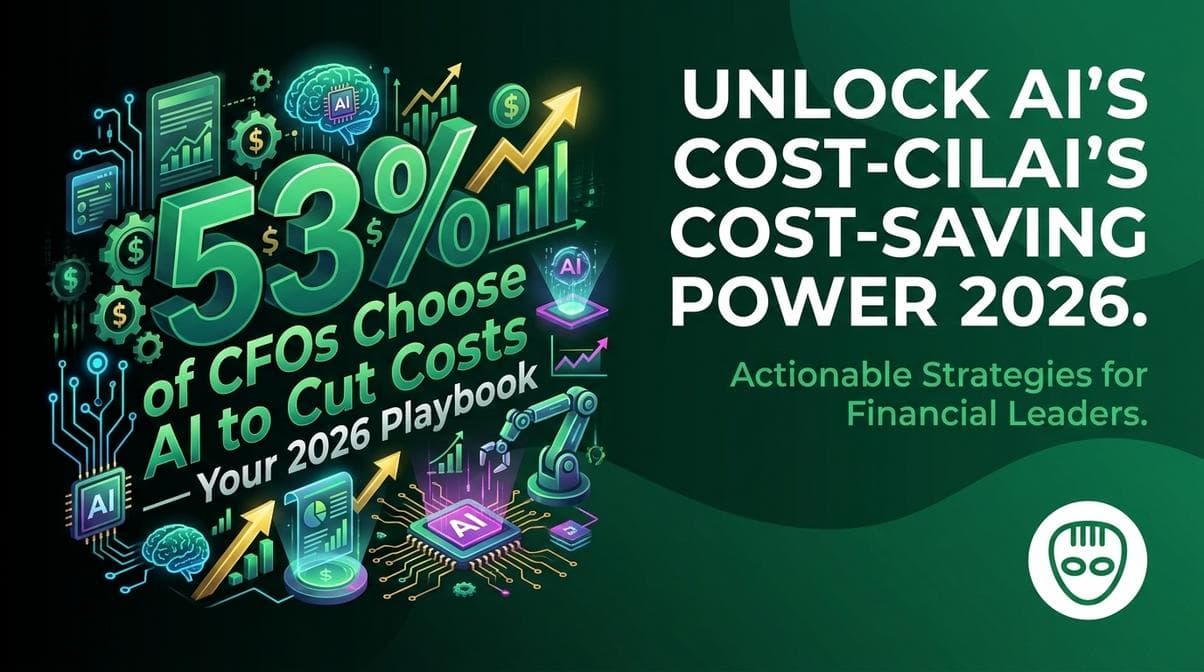
53% of CFOs Choose AI to Cut Costs — Your 2026 Playbook
The Fortune 500's Favorite Cost-Cutting Weapon Is Now Available to You
More than half of America's largest companies now say automation and AI are their single most effective tool for controlling costs. According to Deloitte's Q1 2026 North American CFO Signals survey, 53% of CFOs at billion-dollar organizations ranked "automation or technology upgrades" as the most proven lever for managing rising expenses — ahead of headcount reductions, renegotiating contracts, and every other strategy on the list.
That's not a prediction. That's what's happening right now in boardrooms across the country.
But here's what most small-business owners don't realize: the same AI tools these Fortune 500 CFOs are deploying are now accessible to businesses with five employees and a QuickBooks account. You don't need a $300,000-per-year finance team to get Fortune 500-level financial intelligence. You just need the right tools.
Why Costs Are Squeezing Everyone — Especially Small Businesses
The Pressure Is Real
Deloitte's survey didn't just highlight AI adoption — it revealed why CFOs are scrambling in the first place:
- 52% named cost management as their top internal risk, up from third place just one quarter earlier
- 51% flagged inflation as a persistent external threat
- 52% cited supply chain disruption, jumping from 35% the previous quarter
- 49% feel pressure to invest in emerging tech like cloud and AI just to keep pace
For large companies with dedicated finance teams, these pressures are manageable. For small businesses? They can be existential. You're dealing with the same inflation, the same supply chain chaos, and the same rising costs — but without a 10-person finance department to model scenarios and find savings.
The Small Business Cost Crisis by the Numbers
| Challenge | Fortune 500 Response | Typical Small Business Response |
|---|---|---|
| Rising costs | Deploy AI forecasting tools | Check bank balance and hope |
| Cash flow gaps | Automated AR/AP management | Chase invoices manually |
| Tax optimization | Team of CPAs + AI modeling | Scramble at year-end |
| Financial reporting | Real-time dashboards | Monthly spreadsheet (maybe) |
| Vendor negotiations | Data-driven cost analysis | Gut feeling |
The gap isn't about intelligence or work ethic. It's about access to tools and data. And that gap is closing fast.
The AI Playbook Fortune 500 CFOs Are Using
According to the Deloitte survey, CFOs are prioritizing three specific technologies:
- Cloud-based planning, budgeting, and forecasting — 43% adoption
- Data analytics tools — 43% adoption
- AI (excluding agentic AI) — 40% adoption
Notice what's at the top: not flashy generative AI demos, but practical financial planning and forecasting tools. These CFOs aren't using AI to write emails — they're using it to predict cash shortfalls, optimize spending, and make faster decisions with better data.
What This Looks Like in Practice
When a Fortune 500 CFO deploys AI for cost management, here's what actually happens:
- Real-time cash flow visibility — Instead of waiting for monthly closes, AI monitors transactions daily and flags anomalies
- Predictive forecasting — Models project cash position 30, 60, 90 days out based on actual patterns, not guesses
- Automated categorization — Every transaction is classified, tagged, and ready for analysis without manual data entry
- Variance alerts — When spending in any category exceeds historical norms, the system alerts immediately
- Scenario modeling — "What happens if our biggest client pays 15 days late?" gets answered in seconds, not hours
The Deloitte survey also found that 46% of CFOs identified siloed departments and 39% cited outdated technology as their biggest internal obstacles to cost management. AI solves both problems by centralizing financial data and replacing manual processes.
How Small Businesses Can Run the Same Playbook
Here's the thing: you don't need Deloitte's budget to implement Deloitte's strategy. The AI tools that cost Fortune 500 companies millions to build are now available as affordable SaaS products purpose-built for small businesses.
Step 1: Connect Your Financial Data
The foundation of any AI-powered finance strategy is connected data. If your QuickBooks, Stripe, or Xero data lives in a silo, no amount of AI can help you. The first move is consolidating your financial data into a single platform that can analyze it.
Tools like CFO bot connect directly to QuickBooks, Xero, and Stripe — pulling in transactions, invoices, and payment data automatically. No CSV exports. No manual reconciliation.
Step 2: Automate Your Cash Flow Forecasting
This is the single highest-impact change you can make. The Deloitte survey showed cloud-based forecasting as the #1 technology priority for CFOs — and for good reason. Cash flow surprises kill more small businesses than bad products.
With AI-powered forecasting, you get:
- Daily updated projections based on your actual receivables and payables
- Early warning alerts when a cash gap is approaching
- Seasonal pattern recognition that human analysis often misses
- Scenario planning — see what happens if you hire, invest, or lose a client
Step 3: Get Answers Without Hiring a CFO
One of the biggest advantages large companies have is a CFO who can answer questions on demand: "Can we afford to hire two people this quarter?" "What's our burn rate trending toward?" "Should we delay this purchase?"
An AI CFO like Profit Leap's CFO bot gives you that same capability through a simple chat interface — available 24/7, not just during office hours. Ask questions in plain English and get answers backed by your actual financial data. And when the question gets complex enough to need human expertise, a CPA backstop is there to step in.
Step 4: Eliminate Manual Financial Busywork
The 39% of CFOs who cited "outdated technology and tools" as a cost barrier? For small businesses, that number is likely much higher. Every hour you spend manually categorizing transactions, chasing invoices, or building spreadsheet reports is an hour you're not growing your business.
Automation handles:
- Transaction categorization and tagging
- Invoice tracking and payment reminders
- Financial report generation
- Tax-ready data organization
Step 5: Review and Act Weekly
Data without action is just noise. Set a weekly rhythm:
- Monday: Review your AI-generated cash flow forecast for the week ahead
- Wednesday: Check for any flagged anomalies or budget variances
- Friday: Review your key metrics — revenue, expenses, margins, AR aging
This 15-minute weekly routine gives you better financial visibility than most businesses achieve with monthly accountant meetings.
The Cost Comparison That Should Make You Act
Here's what the Fortune 500's AI finance stack costs versus what's available to you:
| Capability | Enterprise Cost | Small Business Cost (CFO bot) |
|---|---|---|
| AI-powered forecasting | $50,000-200,000/yr | Included |
| Real-time financial dashboards | $25,000-100,000/yr | Included |
| On-demand financial analysis | $150,000-300,000/yr (CFO salary) | Included |
| CPA access for complex questions | $200-500/hr | Included |
| Automated bookkeeping assistance | $30,000-60,000/yr | Included |
| Total | $455,000-1,160,000/yr | A fraction of the cost |
The AI capabilities that Deloitte's survey highlights as mission-critical for billion-dollar companies are now available to a five-person shop. The playing field has never been more level.
The Bottom Line
Deloitte's Q1 2026 survey isn't just a data point about large companies — it's a signal about where all of business is heading. Cost pressure isn't going away. Inflation, supply chain disruption, and rising labor costs are structural realities. The businesses that thrive will be the ones that use AI to see further, act faster, and spend smarter.
Fortune 500 companies figured this out. They're investing billions in AI-powered finance tools because the ROI is undeniable. As a small-business owner, you have the same opportunity — without the enterprise price tag.
The question isn't whether AI will transform how you manage your finances. It's whether you'll adopt it now, while it's still a competitive advantage, or later, when it's table stakes.
Ready to put your finances on autopilot? Try CFO bot risk-free with a 7-day money-back guarantee →