

Q1 Taxes Due April 15 — And 65% of Small Businesses Aren't Ready
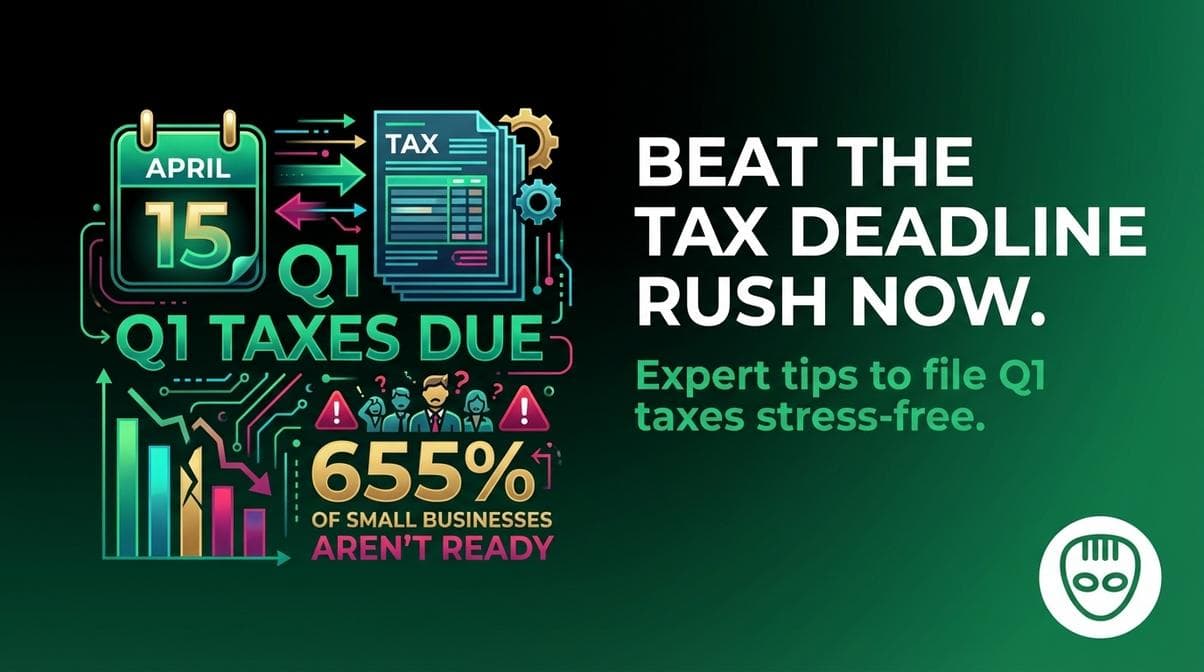
April 15 Is Coming — And Most Small Businesses Aren't Financially Ready
Nearly two-thirds of small businesses have less than three months of cash reserves on hand. That's the finding from a March 2026 report by Revenued, which surveyed thousands of business owners navigating rising costs, tariff pressures, and tightening margins. Now layer on this: Q1 estimated tax payments are due April 15, 2026 — just fifteen days from now.
If you're a sole proprietor, S-corp shareholder, partner, or freelancer who expects to owe more than $1,000 in taxes for the year, the IRS expects a quarterly payment. Miss it, and you're looking at underpayment penalties that compound every quarter you fall behind. For a business already running on thin cash reserves, that penalty can snowball fast.
Here's the reality: three out of four small business owners say cash flow management is their number-one challenge in 2026. And the Q1 tax bill is about to make it worse — unless you have a plan.
Why Q1 Taxes Catch So Many Owners Off Guard
The annual tax deadline gets all the attention. Every financial outlet runs "tax tips" pieces in March. But estimated quarterly payments — the ones that actually matter for most small business owners — barely get mentioned.
Here's how it works: if you're self-employed or run a pass-through entity (LLC, S-corp, partnership), you don't have an employer withholding taxes from your paycheck. Instead, the IRS requires you to pay as you go with quarterly estimated payments. The four deadlines for 2026 are:
| Quarter | Period Covered | Payment Due |
|---|---|---|
| Q1 | Jan 1 – Mar 31 | April 15, 2026 |
| Q2 | Apr 1 – May 31 | June 15, 2026 |
| Q3 | Jun 1 – Aug 31 | September 15, 2026 |
| Q4 | Sep 1 – Dec 31 | January 15, 2027 |
The trap is that Q1's estimated payment deadline falls on the same day as your annual return deadline. So you might owe last year's balance and this year's first quarterly payment on the same date. For a business already stretched thin, that's a double hit to cash flow.
The Penalty Math Nobody Talks About
The IRS underpayment penalty rate is currently tied to the federal short-term rate plus 3 percentage points — right now that's roughly 8% annualized. Skip your Q1 payment and you'll owe penalties on that amount for three full quarters until your annual return is filed.
On a $10,000 quarterly obligation, that's approximately $600 in penalties by year-end. Not catastrophic on its own, but stack that across four missed or late payments and you're looking at $2,400+ in completely avoidable costs. For a business with razor-thin margins, that's real money.
The Cash Flow Squeeze Is Real — Here's What's Driving It
The quarterly tax bill doesn't exist in a vacuum. Small businesses are getting squeezed from every direction in 2026:
- The Fed is holding rates at 3.5%–3.75% and just raised its 2026 inflation forecast to 2.7%. Borrowing to cover a tax shortfall is expensive.
- Tariff-related costs have surged — the average monthly customs duty payment for affected small businesses has jumped from $8,400 to $27,200, a 224% increase in twelve months.
- Rent, wages, insurance, and shipping keep climbing. The general operating cost environment hasn't eased, even as the Fed has cut rates from their 2024 peaks.
- Revenue is uneven. Many businesses saw strong Q4 holiday numbers but are now navigating the typical Q1 slowdown.
The result: when the Q1 tax bill comes due, there's often not enough cash in the operating account to cover it without disrupting payroll, vendor payments, or inventory orders.
Your April 15 Survival Plan: 5 Steps to Take This Week
1. Know Your Exact Q1 Tax Obligation — Today
This sounds obvious, but a shocking number of business owners go into April without knowing what they owe. Your Q1 estimated payment should be roughly 25% of your total expected tax liability for 2026, or 100% of what you owed last year divided by four (whichever is lower satisfies the safe harbor rule).
Pull up your 2025 return. Find line 24 (total tax) on your 1040. Divide by four. That's your minimum safe harbor quarterly payment. If your 2026 income is significantly higher, you'll want to estimate based on current year projections instead.
Pro tip: An AI financial tool like Profit Leap's CFO bot can pull your real-time revenue data from QuickBooks or Xero and calculate your estimated quarterly obligation automatically — no spreadsheet gymnastics required.
2. Separate Your Tax Money Immediately
The single best habit for managing quarterly taxes: open a separate savings account and transfer your tax percentage every time revenue hits your main account. A common rule of thumb is 25-30% of net profit for federal taxes, adjusted for your bracket and state obligations.
If you haven't been doing this and April 15 is looming, calculate what you owe and move that amount into a holding account today — even if it means temporarily reducing your operating cushion. Paying the IRS late is almost always more expensive than the short-term cash flow discomfort.
3. Map Your Cash Flow for the Next 30 Days
Before you write that check to the IRS, you need to know what your cash position looks like through the end of April. That means mapping out:
- Receivables: Who owes you money and when will it actually arrive?
- Payables: What bills are due in the next 30 days?
- Payroll: When does your next payroll run hit?
- Recurring charges: Subscriptions, rent, loan payments, insurance premiums
This exercise takes most business owners 2-3 hours in a spreadsheet. Or you can connect your accounting software to a real-time cash flow forecasting tool that does it automatically. CFO bot syncs with QuickBooks, Xero, and Stripe to show you exactly where your cash will be on any given day — including after that tax payment clears.
4. Explore Your Payment Options If Cash Is Tight
If you genuinely can't cover the full Q1 payment without jeopardizing operations, you have options:
- Pay what you can. The IRS penalty is calculated on the unpaid portion. Paying $7,000 of a $10,000 obligation is far better than paying nothing — you'll only owe penalties on the $3,000 shortfall.
- IRS Direct Pay at irs.gov/payments lets you pay electronically with no fees. You can also use EFTPS (Electronic Federal Tax Payment System) or the IRS2Go mobile app.
- Short-term payment plan. If you owe less than $100,000, you can apply online for a 180-day payment plan with no setup fee.
- Business line of credit. If you have an existing line of credit, using it to cover taxes may be cheaper than the IRS underpayment penalty — compare the interest rates before deciding.
What you should never do: ignore the deadline entirely. The IRS failure-to-pay penalty (0.5% per month) stacks on top of the underpayment penalty, and interest compounds daily.
5. Set Up a System So This Never Happens Again
The businesses that never stress about quarterly taxes have one thing in common: they automated the process. They know their obligation in real time, they set aside money as they earn it, and they have visibility into whether they can cover the payment without disrupting operations.
This is exactly the problem an AI CFO solves. Instead of scrambling every quarter, you get:
- Real-time tax obligation tracking based on your actual revenue data
- Cash flow forecasts that factor in upcoming tax payments automatically
- Alerts when your cash position might not cover an upcoming obligation
- Scenario modeling — "What happens to my cash flow if I defer this vendor payment by two weeks to cover Q1 taxes?"
Profit Leap's CFO bot connects directly to your QuickBooks, Xero, or Stripe account and delivers all of this through a simple chat interface. Ask it, "Can I cover my Q1 estimated taxes and still make payroll on April 20?" and get an answer in seconds — backed by your real financial data, not guesswork. And if the question gets too complex for AI, there's a CPA backstop built in.
What Happens If You've Already Missed Previous Quarters
If you missed estimated payments in 2025, the damage isn't irreversible — but you need to act now. The IRS calculates penalties quarter by quarter, so getting current on your 2026 payments limits future penalty accumulation.
When you file your 2025 annual return (also due April 15), any underpayment penalties for missed 2025 quarterly payments will be calculated and added to your balance. You can request penalty abatement using Form 2210 if you had a reasonable cause — like a sudden drop in income or a natural disaster.
Going forward, the safe harbor rule is your best friend: pay at least 100% of last year's total tax liability (110% if your AGI exceeded $150,000), spread across four equal quarterly payments. Even if you earn significantly more this year, meeting the safe harbor threshold means zero underpayment penalties.
The Bottom Line: Don't Let a Predictable Bill Become a Cash Crisis
Quarterly estimated taxes aren't a surprise. They come four times a year, on the same dates, every year. The businesses that struggle with them aren't bad at math — they're flying blind on cash flow.
When you can see your cash position in real time, forecast where it's headed, and plan for known obligations like tax payments, quarterly taxes become a line item — not an emergency. That's the difference between reacting to your finances and actually managing them.
The tools to do this cost a fraction of what a human CFO charges, and they're available 24/7. The only question is whether you'll set up the system before April 15 — or after the penalty notice arrives.
Ready to put your finances on autopilot? Try CFO bot risk-free with a 7-day money-back guarantee →