

SBA Lost 43% of Its Workforce — Here's Your New Safety Net
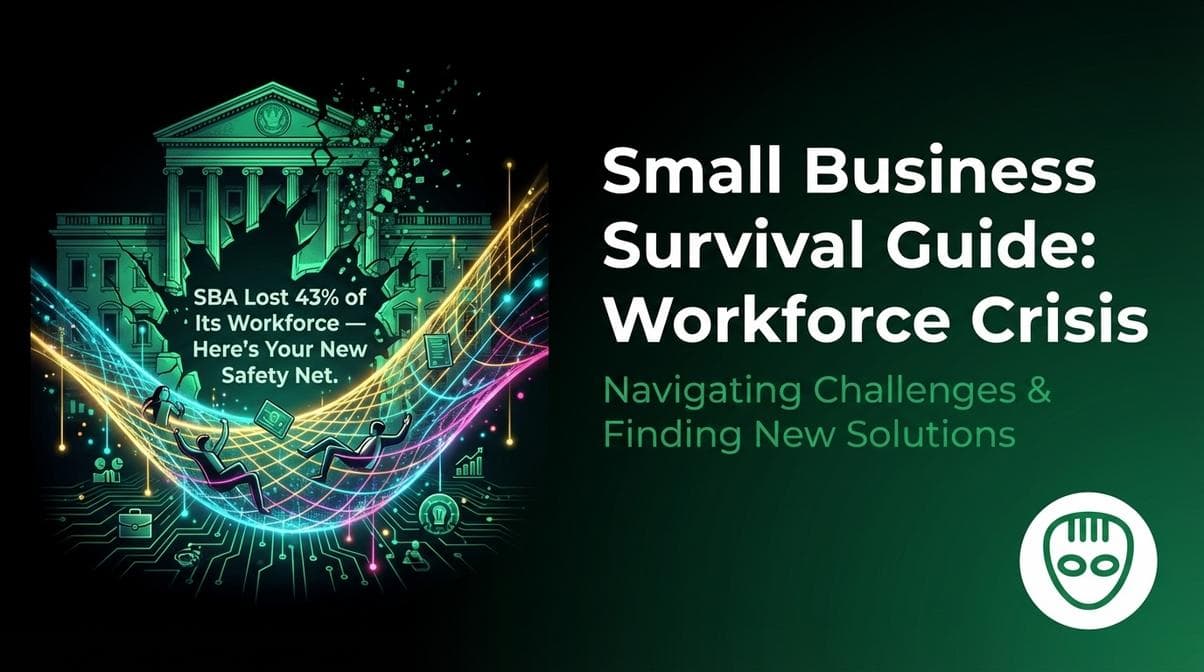
The Government Safety Net You Relied On Is Disappearing
The Small Business Administration is planning to eliminate 2,700 employees — 43% of its entire workforce. That's not a budget trim. That's gutting the single most important federal agency for small business owners in America.
And it doesn't stop there. Federal spending has dropped 16.6% at the fiscal year midpoint, over $41.5 billion in federal contracts have been cancelled, and small businesses held 60% of those terminated contracts. The government programs you may have counted on — disaster loans, counseling services, contracting opportunities — are shrinking fast.
Whether you've directly used the SBA or not, this affects you. Fewer government dollars flowing into local economies means slower sales cycles, tighter credit, and customers who think twice before spending.
The question isn't whether this impacts your business. It's what you're going to do about it.
What's Actually Being Cut — and Why It Matters
The cuts aren't abstract. Here's what's disappearing:
SBA Disaster Loan Program
The SBA has averaged 40,000 disaster loans per year over the past decade, helping small businesses and homeowners recover from hurricanes, fires, floods, and other catastrophes. With nearly half the workforce gone, processing times will balloon and many applicants simply won't get the help they need.
Small Business Counseling and Development
SBA-funded Small Business Development Centers (SBDCs), SCORE mentorship, and Women's Business Centers provide free financial guidance to millions of entrepreneurs. These programs are facing severe staffing and funding cuts.
Federal Contracting Access
Small businesses have historically been guaranteed a share of federal contracts. But with contracting freezes and mass cancellations, that pipeline is drying up. Small firms are being pushed out of federal contracting entirely, and the rate of small businesses exiting the market is now outpacing new entrants.
How the Cuts Stack Up
| What's Affected | Before Cuts | After Cuts | Impact on Small Business |
|---|---|---|---|
| SBA staff | ~6,300 employees | ~3,600 employees | Slower loan processing, less support |
| Federal contracts | $700B+ annually | $41.5B+ cancelled | Lost revenue, broken supply chains |
| Disaster loans | ~40,000/year | Drastically reduced | No safety net after emergencies |
| SBDC/SCORE programs | Nationwide coverage | Reduced services | Less free financial guidance |
| Purchase card spending | Normal operations | Frozen/delayed | Delayed payments to small vendors |
The Ripple Effect: How This Hits Businesses That Never Used the SBA
You might be thinking, "I've never applied for an SBA loan — this doesn't affect me." But here's what happens when the government pulls back this aggressively:
1. Local Economies Slow Down
Federal spending accounts for a significant slice of GDP. When billions of dollars in contracts disappear, the businesses that held those contracts stop hiring, stop buying supplies, and stop spending at local restaurants and shops. The ripple effect reaches businesses three and four levels removed from the original contract.
2. Credit Gets Tighter
Banks watch government spending trends closely. When the economic outlook darkens, lending standards tighten. Small business loan approval rates, which were already declining in late 2025, are likely to fall further. That line of credit you were planning to tap may not be there when you need it.
3. Consumer Confidence Drops
Government employees who lose jobs or face furloughs spend less. Communities near military bases, federal offices, and government-adjacent industries see immediate demand drops. If your customers include anyone in these ecosystems, your revenue is at risk.
4. Competition for Private Capital Increases
With government support shrinking, more businesses are chasing the same pool of private funding. SBA-backed loans — which accounted for nearly 30% of fintech lending — are becoming harder to access. That means higher rates and stricter terms for everyone.
Your 5-Step Survival Plan for a Post-SBA World
You can't control what Washington does. But you can control how prepared your business is for the new reality. Here's your action plan:
Step 1: Know Your Cash Runway — Down to the Day
If you can't answer "how many days can my business survive if revenue drops 20%?" right now, that's problem number one. The average small business has less than 27 days of cash reserves. In a tightening economy, that's cutting it dangerously close.
Calculate your cash runway by dividing your current cash balance by your average monthly burn rate. If the number makes you nervous, you're not alone — and you need to act now, not when the crisis hits.
Step 2: Diversify Your Revenue Streams
If more than 30% of your revenue comes from a single client, industry, or government source, you're exposed. Start building new channels now:
- Add a recurring revenue component (subscriptions, retainers, maintenance contracts)
- Expand your customer base geographically or into adjacent markets
- Build direct-to-consumer channels that don't depend on a single platform or contract
Step 3: Cut the Fat Before You Have To
Don't wait until cash is tight to look for savings. Audit every subscription, vendor contract, and recurring expense. You'd be surprised how many businesses are paying for software nobody uses, insurance they don't need, or services they've outgrown.
Focus on expenses that don't directly generate revenue. Keep your sales and delivery capabilities intact while trimming everything else.
Step 4: Build Relationships With Multiple Lenders Now
The worst time to look for financing is when you desperately need it. Open conversations with your bank, explore fintech lenders, and establish credit lines before you need them. Having access to capital — even if you don't use it — gives you options when the unexpected hits.
Step 5: Get Real-Time Financial Visibility
This is the most important step, and it's where most small businesses fail. You cannot navigate economic uncertainty by checking your books once a month. You need to know exactly where your cash stands, what's coming in, what's going out, and what your forecast looks like — every single day.
That's why thousands of small business owners are turning to Profit Leap's CFO bot. It connects directly to your QuickBooks, Xero, and Stripe accounts and gives you real-time cash flow forecasting through a simple chat interface. Ask it anything — "Can I afford to hire next month?" "What happens to my cash flow if that big client pays late?" "Where am I overspending?" — and get answers backed by your actual financial data, 24/7.
Why AI Is the New Safety Net
The old safety net — government programs, SBA loans, free counseling — was never perfect, but it was something. Now that it's shrinking, small businesses need a replacement. And for the first time, AI makes it possible to get CFO-level financial intelligence without paying CFO prices.
Here's what that looks like in practice:
- Real-time cash flow alerts flag problems weeks before they become crises. Instead of discovering you're short on cash when payroll is due, your AI CFO warns you 30 days out.
- Scenario planning lets you model what happens if revenue drops 10%, 20%, or 30%. No spreadsheet gymnastics required — just ask a question and get an answer.
- Automated expense tracking catches wasteful spending you'd miss in manual reviews. Small leaks sink big ships, and AI never forgets to check.
- CPA backstop means when something falls outside the AI's expertise — tax strategy, entity restructuring, compliance questions — you're connected to a real professional. It's the best of both worlds: AI speed with human judgment.
And the cost? A fraction of what a human CFO charges. We're talking about replacing a $150,000/year hire with a tool that costs less than your monthly coffee budget.
The Bottom Line: Self-Reliance Is the Only Reliable Strategy
Government programs come and go. Administrations change priorities. Budgets get cut. The only constant is that your business needs to be financially resilient regardless of what happens in Washington.
That means knowing your numbers, watching your cash flow, planning for downturns, and making decisions based on data — not gut feelings, not outdated spreadsheets, not a bookkeeper who's two weeks behind.
The businesses that survive and thrive in 2026 won't be the ones waiting for government help. They'll be the ones who built their own safety net.
Ready to put your finances on autopilot? Try CFO bot risk-free with a 7-day money-back guarantee →