

74% of Small Businesses Are Optimistic — But Half Aren't Prepared
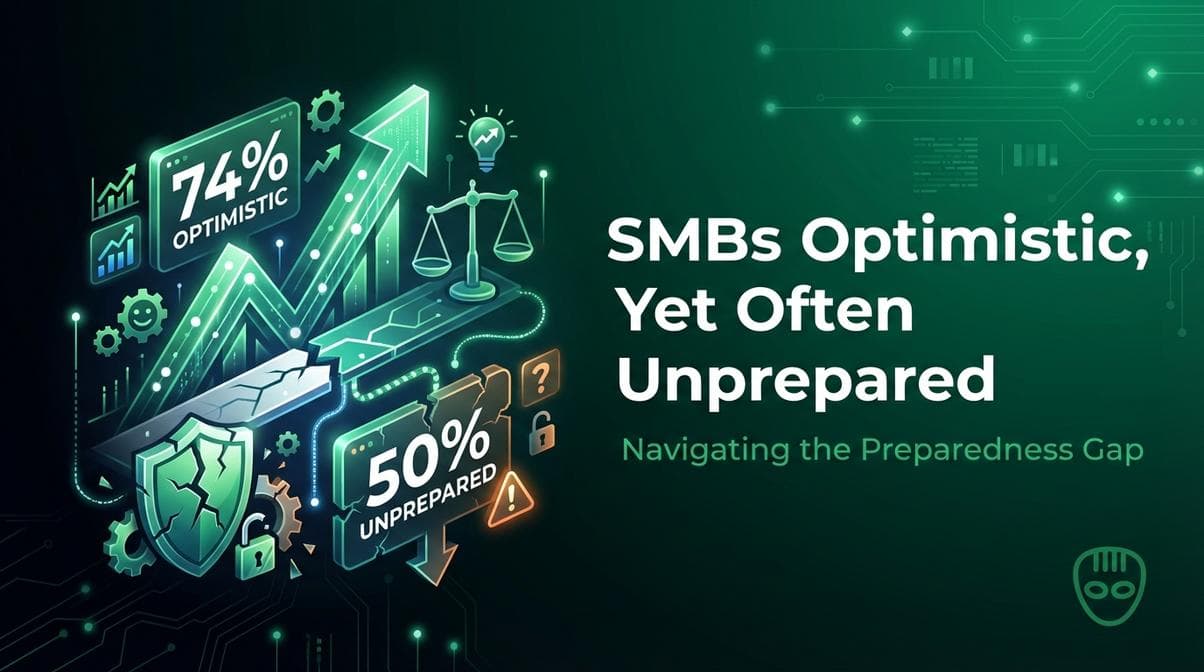
Record Optimism, Risky Gaps: The Hidden Vulnerability in Small Business Confidence
Here's a number that should make you both hopeful and nervous: 74% of small businesses are optimistic about their outlook for 2026.
That's according to JPMorgan Chase's annual Business Leaders Outlook survey, released this month. More than 60% of business owners say they feel more positive about their company now than at any point in the past five years. Revenue expectations are up. Profit expectations are up. Expansion plans are accelerating.
But here's the number that should worry you: only 47% of those optimistic businesses are building cash reserves.
That's not a typo. More than half of small businesses riding high on confidence aren't preparing for the turbulence that could knock them off course. They're optimistic about growth while ignoring the buffer that makes growth sustainable.
If you're in that 53%, this article is your wake-up call.
The Optimism Is Real — And Justified
Let's start with the good news. The JPMorgan survey paints a picture of genuine recovery and momentum:
| Metric | 2026 Outlook |
|---|---|
| Businesses optimistic about their company | 74% |
| Expecting revenue growth | 76% |
| Expecting profit growth | 76% |
| More positive than any time in 5 years | 60%+ |
| Planning to expand in 2026 | 44% |
These aren't speculative hopes. Businesses are citing concrete reasons for confidence:
- Falling interest rates reducing borrowing costs
- Strong consumer spending sustaining demand
- Post-pandemic operational refinements paying off
- Tax policy clarity from recent legislation
The optimism is grounded in real economic tailwinds. But optimism alone doesn't pay the bills when those tailwinds shift.
The Preparation Gap: Where Confidence Becomes Vulnerability
The same survey that captured record optimism also revealed how businesses are responding to uncertainty. And this is where the picture gets complicated.
What Businesses Say They're Worried About
| Concern | % of Businesses |
|---|---|
| Economic uncertainty | 49% |
| Revenue/sales growth | 33% |
| Tariffs | 31% |
| Labor costs and availability | 31% |
| Inflation | 28% |
Half of business owners cite economic uncertainty as a top concern. That's reasonable — the economy remains unpredictable despite current momentum.
What Businesses Are Doing About It
| Response Strategy | % of Businesses |
|---|---|
| Building cash reserves | 47% |
| Renegotiating supplier terms | 36% |
| Investing in marketing | 35% |
| Investing in technology | 34% |
| Adjusting pricing | 29% |
Only 47% are building cash reserves. The rest are relying on external strategies — negotiating harder, marketing more, raising prices — that depend on factors outside their control.
Here's the uncomfortable truth: you can't negotiate your way out of a cash crunch. You can't market your way through missed payroll. When revenue dips unexpectedly — and it does, for even the best businesses — cash reserves are what keep the lights on.
Why Cash Reserves Matter More Than Ever
The businesses that survived 2020-2022 have a visceral understanding of this. The pandemic stress-tested every company's financial resilience. Businesses with 3-6 months of operating expenses in reserve weathered the storm. Those without scrambled for PPP loans, maxed credit lines, or closed altogether.
But memory fades. As confidence returns, so does the temptation to deploy every dollar toward growth.
The Math of Cash Reserves
Here's why building reserves feels hard: every dollar saved is a dollar not invested in revenue-generating activity. For growth-minded owners, reserves feel like opportunity cost.
But consider the alternative math:
Without reserves:
- Unexpected 30% revenue drop → emergency financing at 15-25% APR
- Missed payroll → legal exposure, employee turnover, reputation damage
- Cash crunch during expansion → abandoned investments, wasted capital
With reserves:
- Unexpected revenue drop → draw from reserves, maintain operations
- Slow month → no panic, no emergency debt
- Unexpected opportunity → capital available to move fast
The businesses that grow sustainably aren't the ones that deploy every dollar. They're the ones that maintain a buffer while growing. Reserve capital isn't idle — it's insurance against the unpredictable.
How Much Is Enough? The Cash Reserve Framework
The classic advice is 3-6 months of operating expenses. But that rule of thumb deserves more nuance for small businesses in 2026.
Tier 1: Minimum Viable Reserve (6 Weeks)
This is the absolute floor. Enough to cover:
- One full payroll cycle plus upcoming payroll
- Essential fixed costs (rent, utilities, key subscriptions)
- Minimum inventory replenishment
If you don't have this, you're operating without a net. One delayed customer payment, one slow month, one unexpected expense — and you're in crisis mode.
Tier 2: Stability Reserve (3 Months)
This is where resilience begins. Enough to:
- Weather a temporary revenue slowdown
- Avoid emergency financing
- Maintain vendor relationships during tight periods
- Cover unexpected equipment failures or repairs
Most small businesses should target this level as their working baseline.
Tier 3: Strategic Reserve (6+ Months)
This is the position of strength. Enough to:
- Absorb significant revenue disruptions
- Move aggressively on opportunities (acquisitions, key hires, expansion)
- Negotiate from strength with vendors and landlords
- Sleep well during economic uncertainty
The 47% of businesses building reserves in the JPMorgan survey? They're building toward Tier 2 or 3. The 53% who aren't? They're operating somewhere below Tier 1.
Practical Steps to Build Reserves Without Stalling Growth
"Build cash reserves" sounds simple. In practice, it requires discipline and structure. Here's how to actually do it:
Step 1: Know Your Real Operating Costs
Before you can calculate reserve targets, you need accurate numbers. This means:
- Fixed monthly costs: Rent, utilities, insurance, subscriptions, loan payments
- Variable costs: COGS, commissions, shipping
- Payroll burden: Wages, benefits, taxes
- Owner's minimum draw: What you need to survive personally
Add them up. That's your monthly operating baseline. Multiply by your target reserve months.
Step 2: Treat Reserves Like a Bill
The businesses that successfully build reserves don't "save what's left over." They transfer a fixed percentage to reserves before paying anything else.
A common framework:
- 5-10% of gross revenue transferred to reserves monthly
- Held in a separate account (out of sight, out of temptation)
- Not touched unless true emergency
This compounds faster than you'd expect. A $500,000/year business saving 8% accumulates $40,000 annually — nearly three months of operating expenses for many small operations.
Step 3: Create a Reserve Policy
Define in writing:
- What constitutes an emergency that justifies drawing reserves
- How reserves will be replenished after a draw
- Target reserve levels by quarter or year
This prevents "drift" — the tendency to rationalize dipping into reserves for non-emergencies.
Step 4: Automate the Visibility
You can't manage what you can't see in real-time. Modern financial tools — including AI-powered systems like Profit Leap's CFO bot — provide cash flow forecasting that shows exactly when reserves might be needed and how quickly they're building.
Instead of checking your bank balance and hoping, you can ask:
- "What's my projected cash position in 60 days?"
- "If revenue drops 20%, how long can I operate?"
- "Am I on track for my reserve target this quarter?"
Answers in seconds, based on actual numbers, available 24/7. That's the difference between hoping and knowing.
The Optimism Trap: Why Good Times Are the Worst Time to Get Complacent
Here's the psychological pattern that trips up even smart business owners:
- Business is good → confidence rises
- Confidence rises → investment increases
- Investment increases → cash deploys to growth
- Reserves shrink → "We'll build them back when things slow down"
- Things slow down unexpectedly → no reserves, crisis mode
The cruel irony is that reserves are easiest to build when times are good — yet that's precisely when they feel least necessary. By the time you need them, it's too late to build them.
The 47% of businesses currently building reserves understand this. They're using the current confidence to strengthen their position, not just accelerate spending.
What the Top Performers Do Differently
Looking beyond the JPMorgan survey at broader research on business resilience, a pattern emerges. The businesses that thrive through cycles share common financial practices:
They Know Their Numbers Cold
Not quarterly. Not monthly. Weekly or daily. They know exactly where cash stands, what's coming in, what's going out, and where the gaps might appear.
They Forecast, Not Just Track
Historical accounting tells you where you've been. Forecasting tells you where you're headed. The difference is weeks of lead time to address problems before they become crises.
They Maintain Buffers Even While Growing
Growth and reserves aren't either/or. Sustainable growth means growing at a pace that allows reserve building simultaneously.
They Have a CFO Perspective — Even Without a CFO
The strategic financial thinking that large companies get from CFOs isn't exclusive to large companies. Modern AI tools bring that perspective to businesses that can't afford a $200,000 executive.
Profit Leap's CFO bot exists precisely to fill this gap — providing real-time cash flow analysis, forecasting, and strategic recommendations through a simple chat interface. Connected to QuickBooks, Xero, and Stripe, it surfaces the insights you need without requiring an accounting degree to understand them.
And for complex questions that need human judgment, a CPA backstop ensures you're never navigating uncertain territory alone.
The Bottom Line: Optimism Plus Preparation Wins
The 74% of small businesses feeling optimistic about 2026 are reading the economic signals correctly. The conditions support growth. The momentum is real.
But the 47% who are channeling that optimism into cash reserves are playing a smarter game. They're positioning to capture upside when things go well — and survive when things get bumpy.
The question isn't whether you can afford to build reserves. It's whether you can afford not to. Every dollar in reserves is a dollar of insurance against the unpredictable. Every month of operating expenses saved is a month of runway when revenue hiccups.
The businesses that win through economic cycles aren't the most optimistic. They're the ones that pair optimism with preparation.
Which group are you in?
Ready to put your finances on autopilot? Try CFO bot risk-free with a 7-day money-back guarantee →