

Tariffs Are Squeezing Cash Flow — 5 Moves to Protect Your Business
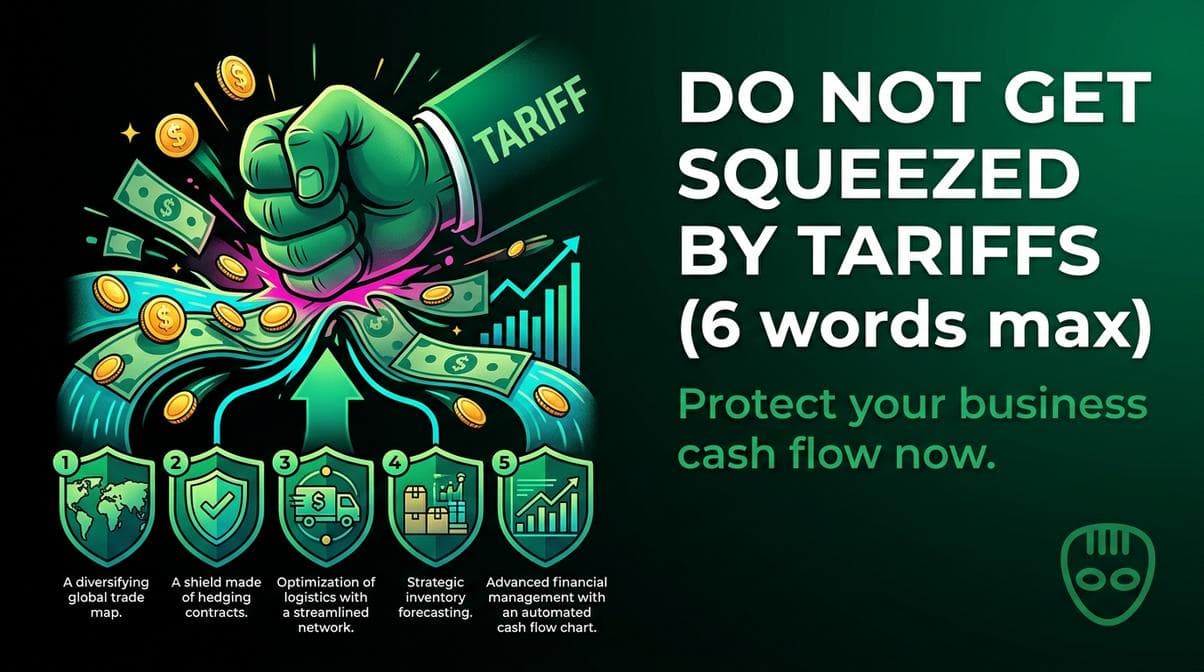
The Tariff Tax Nobody Voted For Is Hitting Small Businesses Hardest
78% of small businesses now report higher operating costs due to tariffs — and three out of four say cash-flow management is their number-one challenge heading into 2026. That's according to a new report from Revenued that paints a stark picture: while large corporations absorb tariff costs across global supply chains, small businesses are taking the hit directly on their bottom line.
If you're a small-business owner watching your supplier invoices climb month after month, you're not imagining it — and you're not alone. The question isn't whether tariffs are costing you money. It's what you're going to do about it before your cash runs out.
Why Small Businesses Bear the Brunt
Bigger Companies Have Options You Don't
Large corporations can shift sourcing to factories in Vietnam, Mexico, or India. They negotiate volume discounts that absorb tariff increases. They have treasury departments running currency hedges and supply-chain teams with decades of experience navigating trade policy.
Small businesses? You're probably buying from the same two or three suppliers you've always used — and those suppliers are passing their tariff costs straight to you.
Analysis from JP Morgan Chase confirms that smaller businesses are much more exposed to tariff impacts due to greater reliance on Chinese imports and fewer alternative trading partners. The Federal Reserve Bank of Atlanta found that small firms expect sales to drop nearly 9% below normal levels due to tariff-related cost increases — compared to just 3.5% for large firms.
The Pass-Through Problem
Here's where it gets really painful. Large firms can pass about 65% of their increased tariff costs through to customers via price hikes. Small businesses? Only about 54%, according to the American Action Forum.
That means for every dollar tariffs add to your costs, you're eating 46 cents out of your own margin. On a business running 15-20% net margins, it doesn't take many rounds of tariff increases to turn a profitable operation into a breakeven one — or worse.
| Impact Area | Large Businesses | Small Businesses |
|---|---|---|
| Cost pass-through to customers | ~65% | ~54% |
| Expected sales decline | -3.5% | -9.0% |
| Alternative supplier access | Many options globally | Limited, often 2-3 suppliers |
| Tariff cost absorption capacity | Distributed across divisions | Hits margins directly |
| Financial planning resources | Dedicated treasury teams | Owner doing it themselves |
Uncertainty Is the Silent Killer
Beyond the direct costs, the unpredictability of tariff policy is paralyzing small-business decision-making. According to the Dallas Fed's 2026 community report, small businesses remain optimistic but face a fog of uncertainty around trade policy that makes it nearly impossible to plan six months ahead.
Should you lock in a bulk order before the next tariff hike? Or hold off in case tariffs get rolled back? Should you raise prices now and risk losing customers, or absorb the costs and hope things normalize?
Every one of these questions costs time, energy, and — if you guess wrong — money.
5 Moves to Protect Your Cash Flow Right Now
The businesses that survive tariff volatility won't be the ones that wait it out. They'll be the ones that adapt their financial operations to move faster than the policy changes. Here's how.
1. Build a Rolling 13-Week Cash Flow Forecast
Stop relying on monthly P&L statements to understand your cash position. By the time you see last month's numbers, the damage is already done.
A 13-week rolling cash flow forecast gives you a week-by-week view of money coming in and going out. It lets you spot trouble 60-90 days before it becomes a crisis — enough time to actually do something about it.
This is exactly the kind of forecasting that AI-powered financial tools excel at. Profit Leap's CFO bot connects directly to your QuickBooks or Xero data and generates real-time cash flow projections automatically, updating as new transactions flow in. No spreadsheet wrangling required.
2. Renegotiate Supplier Payment Terms — Now
When costs go up, timing matters as much as price. Even if you can't negotiate a lower unit cost, extending your payment terms from Net 30 to Net 45 or Net 60 gives your cash more time to work before it goes out the door.
Here's your negotiation playbook:
- Lead with loyalty: "We've been with you for X years and want to keep this relationship strong."
- Offer something in return: Commit to a minimum order volume or longer contract term.
- Ask for early-pay discounts: If they won't extend terms, ask for 2/10 Net 30 (2% discount for paying within 10 days) — then only take the discount when your cash position allows it.
- Get multiple quotes: Even if you stay with your current supplier, having competitive bids gives you leverage.
According to the SBE Council's 2026 survey, 36% of small businesses are actively renegotiating supplier terms as their top strategy for managing rising costs. If you're not in that group, you're leaving money on the table.
3. Diversify Your Supply Chain (Even If It's Painful)
Yes, finding new suppliers takes time. Yes, the alternatives might cost more upfront. But depending on a single source for critical materials in a tariff-volatile environment is a business continuity risk, not just a cost issue.
Start with your highest-cost imported inputs:
- Identify domestic or nearshore alternatives for your top 3-5 imported materials
- Run the total-cost math including shipping, tariffs, lead time, and quality risk
- Split orders between existing and new suppliers to test quality before fully switching
- Consider joining a buying group — small businesses that pool purchasing power can access pricing usually reserved for larger companies
4. Scenario-Plan for Three Tariff Futures
The worst financial plans assume one future. The best ones plan for three:
- Base case: Tariffs stay at current levels for the next 12 months
- Upside case: Some tariffs are reduced or exemptions are granted for your industry
- Downside case: Another round of tariff increases hits your key imports
For each scenario, model the impact on your gross margins, cash position, and ability to meet obligations. This exercise takes a few hours but can save your business.
The Universal Funding 2026 outlook recommends creating monthly cash flow projections for the next 12-18 months incorporating scenarios for tariff shifts, wage inflation, and demand variability. An AI CFO tool like Profit Leap can run these scenarios in minutes by pulling your actual financial data and stress-testing it against different assumptions — something that would take a human bookkeeper days to build in a spreadsheet.
5. Build Your Cash Reserve — Even When It Hurts
The SBE Council survey found that 47% of small businesses are prioritizing building cash reserves as their top financial strategy for 2026. There's a reason it's the number-one response: cash reserves are the difference between surviving a bad quarter and closing your doors.
Rules of thumb for a tariff-volatile environment:
- Minimum: 3 months of fixed operating expenses
- Better: 6 months, especially if you're import-dependent
- Best: 6 months plus a revolving credit line you can tap if needed
If you can't save 3 months of expenses right now, start with a goal of adding 1% of monthly revenue to a separate savings account. It adds up faster than you think — and having $10,000 in reserves is infinitely better than having $0.
Stop Flying Blind With Your Finances
The small businesses that will thrive through tariff uncertainty share one trait: they see problems coming before the problems arrive.
That used to require a full-time CFO — someone who costs $150,000-$250,000 a year and is overkill for a company doing under $10M in revenue. Today, AI has changed the math entirely.
Profit Leap's CFO bot gives you the financial visibility of a dedicated CFO at a fraction of the cost:
- Real-time cash flow forecasting that updates automatically from your QuickBooks, Xero, or Stripe data
- Scenario planning that lets you model tariff impacts in minutes, not days
- 24/7 AI-powered chat that answers your financial questions instantly — "Can I afford this hire?" or "What happens to my cash if supplier costs go up 15%?"
- CPA backstop for complex tax and compliance questions that need a human expert
You don't need to be a finance expert to protect your business from tariff volatility. You just need the right tools and the right information at the right time.
Ready to put your finances on autopilot? Try CFO bot risk-free with a 7-day money-back guarantee →